The Story…Our Story
Richards Cigars: The Havana Legend That Never Died
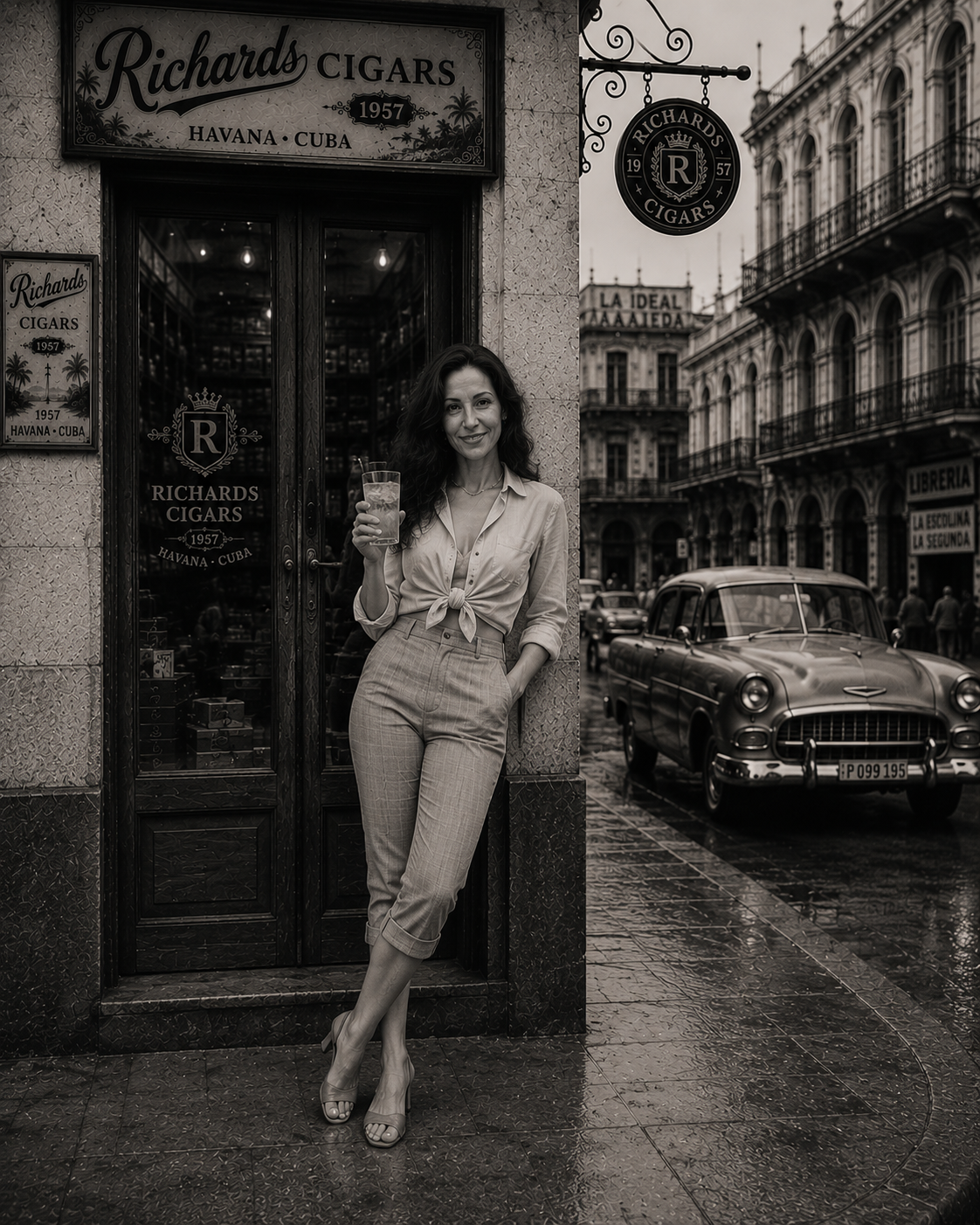
Havana, Cuba — 1957
There was a time when Havana did not simply exist. Havana performed.
The city moved to its own rhythm. Music escaped through open windows and drifted into streets crowded with
automobiles, bicycles, vendors, businessmen, sailors, musicians, tourists, and children chasing one another between
the shadows of buildings that had already witnessed generations of Cuban history. At night, the clubs came alive.
Hotels filled with travelers from New York, Miami, London, Paris, and places even farther away. Rum poured freely,
trumpets played late, and conversations continued long after sensible people had gone to bed.
In the middle of it all was a small cigar shop.
It was not the largest building in Havana, nor the most expensive. It was certainly not the most imposing. Yet everyone
knew
Richards Cigars. Above
the door hung a beautifully painted sign:
RICHARDS CIGARS
HAVANA, CUBA
1957
The lettering was elegant without being pretentious. The windows were polished every morning.
Behind the glass sat cedar boxes stacked like books in a gentleman's library. Inside, the air carried the unmistakable
mixture of Spanish cedar, leather, coffee, tobacco, and something harder to describe.
Belonging.
That was the secret of Richards.
The wealthy came because it was fashionable.
The famous came because they could disappear there.
The locals came because they were family.
Best of all, the street sweepers came because nobody at Richards ever told them they shouldn't.
The story was that Richard himself had established one rule on the day the doors opened.
"The cigar does not care who you are."
A businessman might arrive in a tailored linen suit with a driver waiting outside. Ten minutes later, a dockworker could walk through the same door with dust on his boots and a few coins in his pocket. That’s when the words rang out as they both received the same greeting.
"Welcome to Richards."
There was no private room hidden behind a velvet rope. No table reserved because someone possessed a famous name. There were simply chairs, cigars, conversation, and time, and somehow, at Richards, there was always enough time.
One chair near the front window became particularly famous. Nobody officially owned it. Some mornings it held a banker. By afternoon, a fisherman might be sitting there. At night, perhaps an American actor, a European industrialist, a Cuban musician, or politician would occupy it. The next morning, it belonged to someone else.
Richard liked it that way.
He believed a great cigar could accomplish something politics, money, and social standing rarely could.
It could make people sit still long enough to listen to one another.
Stories began circulating about the people who visited Richards. Famous entertainers supposedly slipped through the doors after midnight. Wealthy Americans stopped on their way between the grand hotels and Havana's nightclubs. Diplomats came without entourages. Writers sat quietly in corners filling notebooks. Businessmen made deals over espresso while musicians argued about baseball at the next table.
Whether every story was true eventually stopped mattering.
The legend became bigger than the guest list.
One of the best-known stories involved a street sweeper named Miguel.
Every morning before sunrise, Miguel worked several blocks surrounding the shop. He would sweep the sidewalks while Havana slowly awakened around him. Richard noticed that Miguel often stopped for a moment outside the window and looked at the cigar boxes.
One morning, Richard opened the door.
"You smoke cigars?"
Miguel laughed.
"Not the ones in your window."
Richard disappeared inside and returned with a cigar.
Miguel shook his head.
"I cannot afford that."
Richard placed it in his hand.
"I didn't ask if you could afford it. I asked if you smoked cigars."
Miguel became a regular.
Years later, customers would tell the story of walking into Richards and seeing a millionaire sitting beside the man who swept the street outside.
Nobody thought anything of it; that was simply the way things are done at Richards.
The shop became known for another tradition.
Every evening at five, someone brewed strong Cuban coffee and placed a pot near the center of the room. Customers poured their own. If you wanted rum, you could find that too. Nobody rushed you. Nobody kept count of how long you occupied a chair.
The philosophy was simple:
Choose well. Cut carefully. Light slowly. Stay awhile.
Richard became obsessive about tobacco.
He traveled through Cuba searching for growers whose leaves possessed something distinctive. He talked to farmers rather than merely purchasing from distributors. He wanted to know the soil, the weather, the harvest, the fermentation, and the hands responsible for rolling each cigar.
Richards did not simply sell cigars, it told their stories.
A customer might walk in asking for the most expensive cigar in the store, only to have Richard recommend something less costly.
"Why?" the customer would ask.
"Because this one suits you better."
That philosophy was unusual then.
It would become the foundation of the Richards legend.
By the late 1950s, Cuba was changing.
Conversations inside the shop became more serious. Political arguments grew louder. Newspapers remained open on tables longer. Customers who had once debated baseball began debating Cuba's future.
Richard resisted allowing the shop to choose sides.
"Outside that door," he reportedly said, "you may disagree about everything. Inside Richards, we begin with what we share."
Then came revolution.
In January 1959, Fidel Castro's forces entered Havana, and the world surrounding Richards changed dramatically.
Businesses faced a new political and economic reality. Families left Cuba. Properties changed hands. Institutions that seemed permanent disappeared almost overnight. Friends who had shared cigars suddenly found themselves separated by borders, politics, and history.
Eventually, Richards could no longer remain Richards.
The doors closed.
The sign came down.
The chairs disappeared.
The cedar boxes vanished.
There was no grand farewell.
That somehow made it worse.
One day there was Richards, then there wasn't.
Yet something unexpected happened.
The store disappeared, but Richards did not.
People carried it with them. A family leaving Cuba brought an old cigar band tucked inside a wallet. Another kept a Richards matchbook in a drawer for decades. Someone preserved a photograph showing three generations standing beneath the Richards sign.
A former customer living in Miami told his children about the place where millionaires and street sweepers sat beside one another.
Another told the story in New York. Another in Madrid. Another in Mexico City. The details changed slightly with each telling, as details often do when stories become legends. Yet one thing never changed.
Everyone was welcome.
Over the decades, people occasionally asked what had happened to Richards Cigars. The answer was usually accompanied by a smile. "Richards?"
Then came the stories. The chair by the window. The coffee at five. The musicians.
The businessmen. The farmers.Miguel and his broom.
The cigar that did not care who you were.
For nearly seventy years, Richards existed primarily in memory.
Until now.
Today, Richards Cigars has returned.
Not as an imitation of 1957 nor as nostalgia manufactured to look old. Rather, as a continuation of an idea that never really disappeared.
The crowned R has returned.
The familiar script has returned.
HAVANA • CUBA • 1957 once again appears beneath the Richards name.
The cigars are selected with the same philosophy: quality before fashion, craftsmanship before volume, and story before status. Yet the most important tradition has returned as well. Everyone still gets the same welcome.
The executive and the mechanic.
The celebrity and the bartender.
The collector with a thousand cigars at home and the person buying his first.
There are no important customers at Richards because every customer is important.
Perhaps that is why the story feels so relevant today.
The world has become faster since 1957. Louder. More connected, yet somehow more divided. We spend our lives rushing from one obligation to another, communicating constantly while sometimes forgetting how to actually talk.
A cigar refuses to participate in that hurry. It asks you to sit. It asks you to wait. It asks you to notice who is sitting beside you.
That was what Richard understood nearly seventy years ago. A great cigar was never merely tobacco wrapped inside tobacco. It was an invitation.
Sit down.
Stay awhile.
Tell me your story.
Somewhere in the imagination, Havana is still alive on a warm evening in 1957.
The automobiles are moving slowly down the street. Music is drifting through an open window. Palm trees bend slightly in the Caribbean breeze. Someone is pouring coffee. Someone else is laughing.
A street sweeper leans his broom against the wall.
A wealthy businessman slides over and makes room.
Richard reaches into a cedar box.
He selects two cigars.
He cuts them carefully.
The match strikes.
For a moment, two men from completely different worlds watch the flame.
Then the cigars begin to glow.
And above them hangs the sign that generations would remember:
RICHARDS CIGARS
HAVANA, CUBA
1957
The building may have disappeared.
The people may have scattered.
History may have changed Cuba forever, but some places are too special to be confined to an address.
They live in stories.
They live in traditions.
They live in the hearts of the people who were fortunate enough to know them—and in the imaginations of those who wish they had.
Richards Cigars is back.
The door is open.
There is a chair waiting.
And just as it was in Havana in 1957—
everyone is welcome.
Let’s Get Started
Ready to stock up or curious about bulk orders? Drop us a quick note and we’ll get back to you with answers, options, and a smile.